Friday, April 22, 2011

UFC 129: GSP vs. Shields Pre-Fight Analysis

Toronto hosts the UFC on April 30th in a first-ever stadium event which will be the largest (and loudest) North American event in MMA history. UFC 129's main event finds welterweight champion George St. Pierre facing top contender and former Strikeforce middleweight champion Jake Shields. Shields, promised a title shot while in negotiations with Dana White, enters a UFC 170-lb division effectively cleaned out by the champion. While fans haven't exactly been clamoring to see two elite wrestlers face off in a five-round main event, in the current welterweight landscape this match up is the only that makes sense.

What We Know

Since reclaiming his belt in 2008 from Matt Serra, George St. Pierre has been a juggernaut at 170 pounds. Dominating victories over the world-class welterweights including Jon Fitch, Thiago Alves, BJ Penn and Josh Koscheck - have fueled reasonable speculation about a move to the UFC's middleweight division.

Making St. Pierre's record more impressive is the fact that in five title defenses, the champion hasn't lost a single round on the score cards. For all the bold predictions and best efforts of the UFC's welterweight contenders, not one has been able to find an answer for GSP's superior athleticism or his relentless and well-rounded attack.

Enter Jake Shields - a relative UFC newcomer and veteran problem-solver who has made a career out of exceeding expectations. With superior wrestling, conditioning and jiu-jitsu, the former collegiate wrestling national champion and top grappler has managed to out-work or otherwise submit many of the world's top fighters over the last six years; Shields' 15-fight win streak includes victories over Carlos Condit, Yushin Okami and most recently Dan Henderson.

What the Tapes Don't Show

Arguably the most athletic fighter in the division, St. Pierre wins - and makes it look pretty easy - by taking opponents out of their comfort zones and keeping them there. While he has been criticized recently as "boring" for not finishing more fights, the game plans he chooses to employ are varied and dynamic, and often involve attacking (and beating) opponents at their strengths. The champion's workhorse style doesn't have the instant replay appeal of fighters like Fedor Emelianenko or Anderson Silva, but to date St. Pierre's smothering offense has proven nearly impossible for any opponent to overcome.
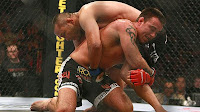
Challenger Jake Shields brings a potentially problematic set of attributes to the table as St. Pierre's opponent. While the champion has handled kick boxers, muy thai fighters and wrestlers all with relative ease, he has yet to face anyone with Shields' combination of wrestling, submissions and most importantly - experience. As champion, Shields has had his chin, his conditioning and his skills tested and has always managed to emerge victorious. His proven ability to bounce back, turn the tables and find a way to win is what sets Jake Shields apart from all previous challengers.

Meanwhile, George St. Pierre hasn't lost a single round since regaining his belt. Members of Shields' camp have an explanation for St. Pierre's routine dominance over the division, pointing out that none his opponents have been able to test the champion. Shields' key to victory may be to take a page out of the champion's book and drag him out of his comfort zone into unknown territory.

How The Fight Could Go

Another key to solving St. Pierre may be understanding his philosophy, which treats MMA more like chess than brawling. One after another, St. Pierre's challengers swing for the fences, strike out and eventually crumble under his pressure. For all the explanations and analyses made, St. Pierre has not yet faced an opponent who can match his simple desire to win.

On Saturday night, however, that may change. Many believe Shields' submission skills are what make him such a dangerous contender, but the California native's cast-iron work ethic and "never-say-die" attitude that make him unique. With the heart of a champion and the experience to match, Jake Shields could be the first guy to take GSP into dark water.

Then again...he may not. George St. Pierre may simply be better than everyone else.

Thursday, March 17, 2011

What to Expect from Rua vs. Jones

UFC 128 dodged a bullet. The addition of Jon Jones as a replacement opponent for 205-lb champ Mauricio Rua almost certainly saves the event from being relegated to ad-supported broadcast on Spike TV. Jones' star power lends interest to a main card decimated by fighter injuries, and perhaps makes Saturday night's headliner the year's most anticipated to date.

What We Know

Mauricio "Shogun" Rua entered the UFC over three years ago greeted with justifiably high expectations. The Brazilian phenom's record in PRIDE included wins over Quinton "Rampage" Jackson, Mark Coleman, Kevin Randleman, as well as a pair of wins over K-1 (and current Strikeforce) terror Alistair Overeem. Rua's introduction to UFC fans at UFC 76:Knockout failed to deliver as promised, as the former PRIDE Grand Prix winner quickly ran out of gas and eventually succumbed to a late choke applied by cardio nightmare Forrest "Lungs" Griffin.

Since his inauspicious American debut, Rua has undergone two knee surgeries to correct an injury which had apparently hindered his performance, and has steadily improved. A sloppy rematch victory over an aging Mark Coleman in 2009 was followed up with an emphatic KO of UFC hall of famer Chuck "The Iceman" Liddell, fast-tracking Rua to a title shot in Octob
er 2009 with elusive karate-man Lyoto "The Dragon" Machida. Despite battering Machida for five rounds and winning over fans, Rua somehow failed to win over the judges and dropped the split decision. Confident in his strategy against Machida and with a serious grudge, "Shogun" preempted the judges altogether the following May in the ensuing rematch, scoring an emphatic first-round KO to silence the critics and seize the UFC light heavyweight title.

Jon "Bones" Jones has been on a steady ascent since his UFC debut in the summer of 2008 against Andre Gusmao. Jones followed up that decision victory with another unanimous decision over veteran brawler Stephan Bonnar in a surprise crowd-pleaser. That match introduced fans to Jones' spectacular wrestling and striking skills, but also raised questions about his gas tank as he spent much of the third round backpedaling from Bonnar.

Those questions remain, though in fairness to Jones only because he has since managed to finish every fight in the first or second round. Jones' win streak in the UFC currently stands at six (not including a questionable DQ loss to Matt Hamill) and is capped off most recently by a dominating submission win over Ryan Bader. Jones surprised everyone by manhandling Bader, a powerful wrestler with deceptively good hands who was expected to give Jones his toughest match-up to date, and after controlling him from the opening moments of the fight finished Bader in Round 2 with a brutal modified guillotine.

What The Tapes Don't Show

Rua reacted to his bitter decision loss to Machida by resolving to make MMA's much-debated scoring system a non-issue. His subsequent first-round KO of Machida was as dramatic and resounding a victory as any title bout in recent memory, looking more like a sixth round than a do-over, but was the result of reflection and study. Wagering that Machida would be preoccupied with defending against his vicious leg and body kicks, Rua's camp spent more time working on his punches and studying Machida's counter-offensive habits in detail, and implemented their game plan with devastating success. Rua's skillful dismantling of the elusive and unorthodox Machida provided coaches and fighters with a clinic on strategy planning and execution.

Speaking of strategy planning and execution, the Greg Jackson-trained Jon Jones hails from arguably the most successful camp in the business. Despite his being the UFC hype machine's employee of the month, Jones is a well-rounded fighter with a much more patient and dynamic game than his highlight reel indicates. He possesses freakish reach, athleticism and exceptionally functional wrestling, but his most dangerous attributes may be his creative problem-solving ability and discipline. Jones seems to have that rare uncanny ability to identify and exploit weaknesses in real-time, a trait reminiscent of Fedor Emelianenko, and as such doesn't waste a lot of energy making mistakes for his opponents to capitalize on.

What Might Happen

Rua and Jones are both thinkers, and neither is likely to charge and brawl. Knowing how (A.) how patiently Rua approached the Machida fight and (B.) that Jones will be cornered by Greg Jackson, I expect this fight to be more of a chess match than a barn burner, and in a five-round fight that means cardio could become a factor. While Rua erased all questions about his conditioning during his five-round war against Machida, it remains to be seen if Jones has the gas tank to keep up, should this fight even make it to the championship rounds.

Styles make fights, and anticipating the outcome of this stylistic match-up is particularly problematic. I expect each fighter to push the action towards each other's weaknesses, but it's hard to say what those are. Clearly Jones' size and reach advantage should be a factor, and while Shogun isn't helpless on the ground I don't expect to see him out-wrestle a wrestler like Jones. On the other hand, Jones' thin lower legs won't be able withstand the savage muy thai leg kicks Rua favors; the "shin factor" may play heavily in the direction the fight takes, if it doesn't end the fight abruptly in gruesome fashion (ala Corey Hill).

For all the problems the UFC encountered solidifying a main card, the Rua vs. Jones title bout makes this event worth tuning in.

And even if the main event doesn't deliver, perhaps Dana White will enter the Octagon and explain to Joe Rogan how Zuffa's recent acquisition of the fans' and fighters' only alternative to the UFC will actually benefit the fans and fighters.

Monday, January 10, 2011

Fedor Returns to Cure MMA Boredom Epidemic


The world of mixed martial arts finally has something to look forward to. On February 12th, Russian legend Fedor Emelianenko returns to face Brazilian contender Antonio "Bigfoot" Silva in the quarterfinals of Strikeforce's heavyweight Grand Prix.

Who knows why it took so long seal the deal; maybe Fedor's manager Vadim Finkelstein wouldn't budge on that rumored private-label amusement park provision. Who knows and who cares, the ends justify the means for Fedor's fans.

In any case this matchup is a good one. Silva poses as great a threat as Fedor has yet faced for a few reasons:
  • He's bigger. Force is equal to mass multiplied by acceleration, folks. Silva is an athletic 260lbs, and at 6'4" he sports a significant reach advantage and will probably look very comfortable on his feet (his ever-improving stand-up game gave Freddie Roach-trained Andrei Arlovski fits last year.) Rogers showed us all how a bigger man could use the cage to keep Fedor from making mischief. I expect Silva to be one of the first of Fedor's opponents to purposefully exploit the size advantage.
  • He's dynamic. I first saw Silva in action in a sloppy brawl against Ricco Rodriguez. Both men looked out of practice and slightly out of shape, with Silva getting the split decision victory. Since then, "Bigfoot" shown both improved skill and improved conditioning, and enters this fight at no real disadvantage, on the ground or standing.
  • He's patient. Certainly the "Fedor jitters" played a part in the Russian's many shocking wins over larger, faster and stronger opponents. Both Tim Sylvia and Brett Rogers hesitated before the stalking Russian, only to find themselves looking up at the ref and wondering what happened. Antonio Silva came back against Mike Kyle after getting knocked on his ass in the opening moments of the fight; with that lesson in humility behind him it's highly unlikely that Fedor will catch him napping.
  • He (now) knows Fedor can be beaten. All Silva needs to know is that what one man can do, another can do. Like the rest of us I'm sure Silva crapped his pants when Fedor tapped. It also probably didn't escape his attention that Fedor, to be blunt, gave up that submission quite carelessly. Fedor's "ad hoc" fighting style doesn't rely as much on opponent-specific strategy so much as real-time analysis and reaction. There's no question that Fedor is willing to take a lick or two while he feels his opponent out for weaknesses; if Silva's smart, he'll be ready to exploit Fedor's inhuman lack of fear the way Fabricio Werdum did.
On the other hand..this is of course Fedor. Though it doesn't need to be said, I'll say it anyway:
  • He can do it all. Fedor is as well-rounded as anyone who has ever fought. He isn't big, but he has The Big Punch. He's probably not the fastest athlete fighting today, but his uncanny timing and balance give him the jump on nearly everyone he's fought. He may not be a world-champion competitive Abu Dhabi grappler, but he applies submissions like his life depends on it. He really doesn't neglect any one facet of the game.
  • He has experience. Fedor has 32+ professional wins at heavyweight. He's fought strikers, grapplers, pure wrestlers, kickboxers and everything in between. That record really is compounded by the fact that, since he doesn't believe in cutting weight, he for all practical purposes is fighting guys from a higher weight class. Picture Frankie Edgar fighting at middleweight to appreciate the significance of this.
  • He's committed to ending the fight. Fedor isn't fighting for points. He treats fighting as problem-solving and his opponents like strategy puzzles; give him a few minutes, and he'll solve the problem. He's ended fights by every means imaginable, from arm-bar to kimura to short-choke to TKO, to one-punch knockout and majority decision. The unified rules of MMA make it technically possible and even advantageous for fighters to secure victory by winning over the judges, Fedor doesn't seem to care about winning the round.
  • He's fearless. It has been said of Fedor that he "cuts easy," but that's just statistics out of context. The practical reality is that Fedor presses the action in nearly every fight without any real fear of getting hit. Perhaps he's willing to get tagged once or twice simply as a means to determining the extent of someone's range. The much-larger Brett Rogers, knocked out by Fedor after briefly appearing to have the advantage in their fight, said later that he was thrown off by how "loose" Fedor seemed. Indeed, Fedor's willingness to wade into harm's way against larger opponents is unsettling to behold, and probably even more so from inside the cage.
Fedor vs. Silva can go either way, it really can. Size considerations notwithstanding, both fighters are skilled, tough and smart, so I won't predict a winner. I hope only for a good fight, and knowing what I know about these two fighters I don't expect anything less.


Wednesday, December 8, 2010

The Most Ironic Man on the Planet

Legendary Russian mixed martial artist Fedor Emelianenko, dubbed "The Baddest Man on the Planet" by Western media, frankly isn't a good fit for the UFC. For all the growth in the MMA audience for which Dana White and Zuffa is responsible, the hyper-macho blood thirst cultivated by their marketing partners does as much to prevent its mainstream acceptance.

Fedor has little use for this characterization of what he thinks of ultimately as a sport and nothing more:
Aggression is not something generated by this or that sport; it's personalities that are aggressive. And it's a general rule everywhere, not only in sports, but in everyday life too. If people are used to being rude to each other, being hostile, they will be the same in their everyday life. This is why, of course, things do happen. Fighters often tend to forget they are primarily human beings. They're so carried away with the show, that they become engulfed by this inexplicable aggression, or a show of aggression which is meant to attract attention. I'm not a supporter of such things.
(link to interview)

Unburdened by delusions of omnipotence, Fedor quite naturally has lost very few fights. Still, it strikes me as ironic that the fighter most likely to win any given fight is the one who seems to place the least existential value on the fight's outcome.

Monday, November 22, 2010

UFC 123 Wrap-Up

After an extended dry spell, UFC 123 has compelled me to weigh in on some of the organization's top fighters and the state of MMA in general.

What Happened

The co-main event, Lyoto "The Dragon" Machida vs. Quentin "Rampage" Jackson, predictably went the distance in a competitive if cautious fight featuring two former champions looking to rebound. Machida, an elusive and defensive fighter well-known for his confounding combination of sumo and karate, employed a more conservative strategy than usual against a fighter whom, in all fairness, he may not match up very well against. Machida's abrupt countering style - charging in head first - got him in big trouble in May when Brazilian chute box veteran Mauricio "Shogun" Rua saw it coming and timed a big overhand to knock out The Dragon in his first title defense. Jackson, arguably the division's stand-up fighter, had little trouble finding his range but played a smart fight and took the proper angles to land the occasional shot and keep Machida back-pedaling. Machida, meanwhile, showed flashes of brilliance with a 3rd-round flurry and big take-down, but it was too little, too late in the eyes of the judges, who awarded a split-decision victory to the more aggressive Jackson.

What I Think It Means

The fight game continues to evolve. Machida's defensive, unorthodox style confused enough fighters for enough fights to become the champion, but nonetheless proved too static to weather a single title defense against a fighter with a more dynamic approach to fighting. People have solved Machida's strategy; Shogun exposed his greatest weaknesses and exploited them - not once, but twice. Rampage Jackson, employing both patience and an advantage in the striking game, demonstrated once more that "fighting to win" trumps "fighting not to lose" every time. As dominant as George St. Pierre is at welterweight, the sport will inevitably evolve beyond his increasingly conservative, wrestling-oriented style of fighting.

What Else Happened

BJ Penn, whom Freddie Roach called the best boxer in MMA, finally did something with those dangerous hands of his and knocked out Matt Hughes at welterweight. What I assumed was a nostalgic retirement-party rubber match for the two former champions turned out instead to be a rebirth of "The Prodigy" Penn at 170lbs after being driven from the UFC's lightweight division by Frankie Edgar.

George "Who?" Sotiropoulos, a Greek Australian TUF alumnus, continues to make his case to the UFC's apparently deaf ears for a spot in 155-pound title contention. After a disappointing fluke knockout against the show's eventual runner-up, Sotiropoulos has been born again hard. Since TUF, Sotiropoulos has torn through the division like wet toilet paper, destroying Roman Mitichyan, George Roop, the hard-punching Jason Dent, Joe Stevenson, and Kurt Pellegrino to amass a 5-0 record entering Saturday's fight against the prodigious young Joe Lauzon. Lauzon, who criticized Sotiropoulos' style as "safe," opened the first round aggressively with some success landing shots before being controlled against the cage by Sotiropoulos. The second round really showed marked contrast in the two fighters' level of preparation, as Lauzon sucked wind while Sotiropoulos picked up speed and changed levels. Once the fight went to the ground, it was only a matter of time and the dangerous Sotiropoulos outworked Lauzon to secure a kimura arm lock and tap in round two.

What I Think It Means

Regarding Penn - who knows. BJ Penn is an odd cat, an eccentric guy. When his head is in it, he's arguably the most well-rounded fighter and skilled fighter on the planet. He entered the arena mumbling to himself and abruptly tried to flee the cage after knocking out Matt Hughes in 21 seconds. Penn is an enigma and will likely stay that way. Dana White has announced Penn will next face Jon Fitch at welterweight. Fitch, a taller 170-pounder, provides possibly the best example of what some fans call "lay-and-pray," a one-dimensional fighting style which relies on success take downs to secure the decision victory. White's decision could be viewed as retaliatory or punitive, as Fitch has repeatedly demanded a shot at the title while simultaneously refusing to face his training partner and fellow contender Josh Koscheck. Whatever his reasoning, if nothing else the stylistic match-up is an exciting one, as Penn's diverse and skilled game have proven to be an advantage against nearly all fighters. This is the fight the fans want to see; the division's most boring fighter vs. the division's most enigmatic, talented and arguably dangerous fighter.

Regarding Sotiropoulos - I don't even know where to start. This guy is just great...his pre- and post-fight interviews demonstrate maturity, respect for his opponents and his employer, and in general just a pretty balanced outlook on life in general. With his lanky old-man physique and knee braces, he's not much to look at, but it stands in perfect contrast to a fighting style defined by superior conditioning, diligent training and cast-iron determination. George Sotiropoulos does not have Frankie Edgar's speed or Gray Maynard's strength or Nate Diaz' confidence, but he apparently he doesn't need them. He wins by working harder AND smarter. Why the UFC has rewarded his efforts by matching him laterally against Dennis Siver, cut from the UFC in 2008 only to be re-signed last year - is a mystery. I don't think anyone, after watching Sotiropoulos submit Joe Lauzon, would have visualized Siver standing between Sotiropoulos and the lightweight title shot, but it's a moot point. It doesn't matter what I think, it matters what the UFC brass thinks, and the last person in the world who is going to complain about it is George Sotiropoulos. Look for big things from George in 2011.

Friday, July 9, 2010

Machida Calls For Do-Over Via Rashad Evans Rematch

The championship belt many thought karate revivalist Lyoto Machida would hang onto for a while is now the property of Mauricio "Shogun" Rua, who looks to sit on it for a while as he undergoes another knee surgery.

Shogun's decisive victory over Machida laid to rest any questions about the former PRIDE legend's potential. Shogun shocked the world last year, literally kicking away Machida's former aura of invincibility. Robbed of the victory many felt he earned the first time, Rua walked into the Octagon this May resolved to

The unfortunate effect of Machida's devastating knockout loss is that the concussion seems to have either erased his memory or altered his judgement. Machida's management is apparently now interested in an "interim" title fight with Rashad Evans, the same fighter Machida knocked out to win the title originally. Evans, a solid contender and technically the first in line for a title shot at Shogun, has nonetheless turned in lackluster lay-and-pray wins in his last two outings against Thiago Silva and Rampage Evans.

The first problem with a Machida-Evans rematch is the notion that a newly-dethroned champion in any division can simply demand an instant shot at the title. Even George St. Pierre, whom most agree simply didn't show up to fight a disrespected Matt Serra, had to earn his dinner by manhandling Josh Koscheck and then destroying Matt Hughes before he earned a rematch with Serra. In fairness to a very competitive 205lb division, Machida needs to get in line and prove he can still swim in the deep end before he gets a shot at redemption.

The second problem with this rematch is that it denies Evans the fruit of his lay-and-pray efforts: a fight with Mauricio Rua. Rules are rules, and there's no rule that says a fighter can't rely heavily on wrestling ability to win fights. Evans, while not an exciting fighter lately, has earned his shot at Shogun's belt, and - Machida - the guy Shogun annihilated to become champion - is in no position to make this demand of Evans and the UFC's matchmakers.

The third problem is more subjective. Machida, in their first outing, matched very well against a tentative and jittery Evans, who got away from his bread-and-butter wrestling ability and tried to trade strikes with an accomplished competitive karate-man. Machida's camp probably like their chances against Evans, and see a rematch with him as an easy way to leap-frog over the rest of the division's contenders back to a title shot with Shogun.

In lobbying for a Shogun rubber match by way of Rashad Evans, Machida's camp is exercising the "Do over!" impulse some fighters demonstrate immediately after a devastating loss, eager to erase the moment from our collective consciousness with a spectacular Mulligan rematch. I haven't ever seen good things ever come of this phenomenon, as it demonstrates emotional binding or attachment. Fighters who tether themselves to an ideal - whether that is a stubborn and inflexible game plan, a refusal to retire, or a personal need to be described by others as the world's greatest - are attempting to secure outcomes of events beyond their control. That's reality.

I would personally like to see Machida rematch Thiago Silva, who has certainly earned his own shot at redemption, or perhaps a tune-up fight against Rampage Jackson. By having to earn his shot the old-fashioned way, like everyone else, Machida will demonstrate the character of a champion by acknowledging his fall and then quietly picking himself up again. I look forward to seeing that happen.

Saturday, May 22, 2010

UFC 1 Lowlights and Highlights

I just watched YouTube footage of UFC 1, with former PKA champion kick boxer and movie star Bill "Superfoot" Wallace in the broadcast booth. Royce Gracie tapped out pro boxer Art Jimmerson, who looked a little out of his element being smothered by a Brazilian in a gi.

Wallace's botched introduction more than made up for it. Watch and enjoy as dinner makes a break for it at the 13-second mark:


Followers