Showing posts with label fedor emelianenko. Show all posts

Friday, April 13, 2012

Five Reasons Dos Santos vs. Fedor Makes Sense


The future looks grim for UFC 146: Dos Santos vs. Overeem. Though Alistair Overeem's failed drug test comes as no surprise to those who have followed him since his lanky K-1 days, the timing couldn't be much worse. Desperate fans have taken to lobbying via Twitter for journeyman Mark Hunt as a potential replacement to face Junior Dos Santos (a rumor summarily quashed by UFC President Dana White.)

With the short list of suitable replacements looking very short indeed, a novel idea would be for White to sign Russian legend Fedor Emelianenko to challenge Dos Santos for the UFC heavyweight title.

Given White's acrimonious history with Fedor's management, the possibility seems as unlikely to ever become a reality as it is intriguing, but there is real logic behind it. Considering White's promotional savvy and history of confounding expectations, one should never say never.

Here are five reasons why Dos Santos vs. Fedor actually makes a lot of sense.

#1: Contention Doesn't Matter, It's a Business

Although Fedor's recent record may not seem to warrant an immediate UFC title shot, the determination of UFC contenders historically seems more academic than quantitative. From Forest Griffin and Brock Lesnar to Dan Hardy and more, many fan favorites have been given a fast track to the title shot as matchmakers strategically select the most marketable and stylistically interesting fighters from their pool of candidates.

While the UFC's "black box" title contention algorithm may not satisfy purists or statisticians, their fan-driven approach to matchmaking has paid off with record pay-per-view sales, and there's no question Dana White has done a great job selling fans the fights they want to see.

#2: Marketability

Whether you consider him the world's greatest or completely overrated, Fedor Emelianenko is without question responsible for some of the most exciting moments in mixed martial arts history. With a fearless style that keeps fans around the world on the edges of their seats, Fedor's star power gives him the unique leverage to repeatedly pass on a UFC contract and yet still maintain a lucrative fighting career.

Junior Dos Santos has more in common with Fedor than perhaps any other professional fighter. The Brazilian's jovial, everyman personality and sense of humility stands in ironic contrast to the reputation he has earned as the world's most feared heavyweight striker.

For a young sport still struggling with an image problem, a main event pairing two world-class fighters and exemplary sportsmen gives the UFC an opportunity to make inroads into markets their current brand cannot reach.

#3: Personnel Shortages

The recent departure of pay-per-view goliath Brock Lesnar leaves a gaping hole in the UFC's heavyweight division. With main event regulars Shane Carwin and "Minotauro" Noguiera out due to injury and younger prospects Brendan Schaub and Matt Mitrione ostensibly out of contention due to recent losses, the UFC is short on any obvious choices for a replacement for Overeem.

The addition of Fedor Emelianenko to the UFC's heavyweight division not only gives Zuffa an instant replacement for Overeem but a monopoly on MMA's heavyweight superstars. Although Fedor is undersized compared to the UFC's heavyweights, he has made a career of fighting and beating bigger, stronger opponents (including two former UFC heavyweight champions, Tim Sylvia and Andrei Arlovski.)

#4: The Timing is Perfect

This spring's run of twelve consecutive weeks without a pay-per-view event represents the longest UFC pay-per-view drought in recent history. With The Ultimate Fighter TV ratings on a steady decline, the undoing of Dos Santos vs. Overeem threatens to slam the brakes on the UFC's summer momentum.

Meanwhile, Fedor Emelianenko has been training all spring, ostensibly in preparation for a tentative early summer match up with a yet-unnamed opponent from a short list of mid-tier fighters. After three consecutive losses in Strikeforce - the first of his career - Fedor's two most recent victories show improvement upon his exciting but arguably reckless style.

At a time when MMA is getting most of its publicity for the wrong reasons (see: TRT, pro wrestling,) the addition of Fedor to UFC 146 would bring much-needed appeal and instant legitimacy to the event.

#5: It's a Win-Win Situation for Dana White

Since walking away from tedious and protracted negotiations with Fedor's management two years ago, White has gone on the record to remind the world just how "overrated" he believed the Russian fighter always was. In considering Emelianenko as a last-minute replacement for Overeem, therefore, White may seem to be faced with a dilemma and risk looking like a hypocrite.

As a savvy business promoter, however, White probably knows he can't lose. If Dos Santos wins, White was right about Fedor all along, but conversely if Fedor manages to upset Dos Santos, the world's greatest is now the exclusive property of Zuffa, LLC. Either way, there's no risk here for Zuffa. Everyone wins.


Monday, January 10, 2011

Fedor Returns to Cure MMA Boredom Epidemic


The world of mixed martial arts finally has something to look forward to. On February 12th, Russian legend Fedor Emelianenko returns to face Brazilian contender Antonio "Bigfoot" Silva in the quarterfinals of Strikeforce's heavyweight Grand Prix.

Who knows why it took so long seal the deal; maybe Fedor's manager Vadim Finkelstein wouldn't budge on that rumored private-label amusement park provision. Who knows and who cares, the ends justify the means for Fedor's fans.

In any case this matchup is a good one. Silva poses as great a threat as Fedor has yet faced for a few reasons:
  • He's bigger. Force is equal to mass multiplied by acceleration, folks. Silva is an athletic 260lbs, and at 6'4" he sports a significant reach advantage and will probably look very comfortable on his feet (his ever-improving stand-up game gave Freddie Roach-trained Andrei Arlovski fits last year.) Rogers showed us all how a bigger man could use the cage to keep Fedor from making mischief. I expect Silva to be one of the first of Fedor's opponents to purposefully exploit the size advantage.
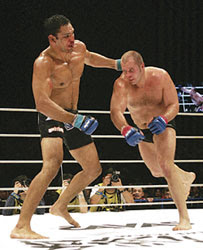
  • He's dynamic. I first saw Silva in action in a sloppy brawl against Ricco Rodriguez. Both men looked out of practice and slightly out of shape, with Silva getting the split decision victory. Since then, "Bigfoot" shown both improved skill and improved conditioning, and enters this fight at no real disadvantage, on the ground or standing.
  • He's patient. Certainly the "Fedor jitters" played a part in the Russian's many shocking wins over larger, faster and stronger opponents. Both Tim Sylvia and Brett Rogers hesitated before the stalking Russian, only to find themselves looking up at the ref and wondering what happened. Antonio Silva came back against Mike Kyle after getting knocked on his ass in the opening moments of the fight; with that lesson in humility behind him it's highly unlikely that Fedor will catch him napping.
  • He (now) knows Fedor can be beaten. All Silva needs to know is that what one man can do, another can do. Like the rest of us I'm sure Silva crapped his pants when Fedor tapped. It also probably didn't escape his attention that Fedor, to be blunt, gave up that submission quite carelessly. Fedor's "ad hoc" fighting style doesn't rely as much on opponent-specific strategy so much as real-time analysis and reaction. There's no question that Fedor is willing to take a lick or two while he feels his opponent out for weaknesses; if Silva's smart, he'll be ready to exploit Fedor's inhuman lack of fear the way Fabricio Werdum did.
On the other hand..this is of course Fedor. Though it doesn't need to be said, I'll say it anyway:
  • He can do it all. Fedor is as well-rounded as anyone who has ever fought. He isn't big, but he has The Big Punch. He's probably not the fastest athlete fighting today, but his uncanny timing and balance give him the jump on nearly everyone he's fought. He may not be a world-champion competitive Abu Dhabi grappler, but he applies submissions like his life depends on it. He really doesn't neglect any one facet of the game.
  • He has experience. Fedor has 32+ professional wins at heavyweight. He's fought strikers, grapplers, pure wrestlers, kickboxers and everything in between. That record really is compounded by the fact that, since he doesn't believe in cutting weight, he for all practical purposes is fighting guys from a higher weight class. Picture Frankie Edgar fighting at middleweight to appreciate the significance of this.
  • He's committed to ending the fight. Fedor isn't fighting for points. He treats fighting as problem-solving and his opponents like strategy puzzles; give him a few minutes, and he'll solve the problem. He's ended fights by every means imaginable, from arm-bar to kimura to short-choke to TKO, to one-punch knockout and majority decision. The unified rules of MMA make it technically possible and even advantageous for fighters to secure victory by winning over the judges, Fedor doesn't seem to care about winning the round.
  • He's fearless. It has been said of Fedor that he "cuts easy," but that's just statistics out of context. The practical reality is that Fedor presses the action in nearly every fight without any real fear of getting hit. Perhaps he's willing to get tagged once or twice simply as a means to determining the extent of someone's range. The much-larger Brett Rogers, knocked out by Fedor after briefly appearing to have the advantage in their fight, said later that he was thrown off by how "loose" Fedor seemed. Indeed, Fedor's willingness to wade into harm's way against larger opponents is unsettling to behold, and probably even more so from inside the cage.
Fedor vs. Silva can go either way, it really can. Size considerations notwithstanding, both fighters are skilled, tough and smart, so I won't predict a winner. I hope only for a good fight, and knowing what I know about these two fighters I don't expect anything less.


Wednesday, December 8, 2010

The Most Ironic Man on the Planet

Legendary Russian mixed martial artist Fedor Emelianenko, dubbed "The Baddest Man on the Planet" by Western media, frankly isn't a good fit for the UFC. For all the growth in the MMA audience for which Dana White and Zuffa is responsible, the hyper-macho blood thirst cultivated by their marketing partners does as much to prevent its mainstream acceptance.

Fedor has little use for this characterization of what he thinks of ultimately as a sport and nothing more:
Aggression is not something generated by this or that sport; it's personalities that are aggressive. And it's a general rule everywhere, not only in sports, but in everyday life too. If people are used to being rude to each other, being hostile, they will be the same in their everyday life. This is why, of course, things do happen. Fighters often tend to forget they are primarily human beings. They're so carried away with the show, that they become engulfed by this inexplicable aggression, or a show of aggression which is meant to attract attention. I'm not a supporter of such things.
(link to interview)

Unburdened by delusions of omnipotence, Fedor quite naturally has lost very few fights. Still, it strikes me as ironic that the fighter most likely to win any given fight is the one who seems to place the least existential value on the fight's outcome.

Wednesday, April 28, 2010

Fedor's Most Dangerous Opponent: His Management

I'm saying it now: the enigmatic Russian heavyweight fighting legend known as Fedor Emelianenko is in danger of becoming irrelevant.

I will give Dana White his due credit. He saw two years ago an erratic pattern of questionable decision-making from Fedor's handlers, and after talks to acquire Fedor fell through, the UFC president angered fans all over the world when he referred to the PRIDE legend as "a farce."

It turns out Dana White was right. While the UFC's heavyweight picture becomes increasingly complicated due to the incredible depth and parity in the division, Strikeforce scrounges around to find reputable advertising partners to support broadcasts of "title" fights with any name fighter who will give sign a contract with them.

Get this. Strikeforce is talking about matching Fedor - ostensibly the world's #1 pound-for-pound fighter and top heavyweight - against Fabricio Werdum, an accomplished and competitive heavyweight who most recently ground out a split decision against Antonion "Bigfoot" Silva. Meanwhile, Emelianenko's most recent victim, Brett Rogers, is fighting a puffy Dutch powerlifter and K-1 kickboxer for the frickin' belt.

I don't get it. I may be only a fan of MMA, but this doesn't make any sense. Shouldn't the #1 heavyweight be facing the world's #2 heavyweight? Werdum, who was cut by the UFC after being stopped by hammer-fisted contender Junior Dos Santos, is a good fighter, but he isn't #2 by any stretch of the imagination. His presence in the MMA Weekly world heavyweight top-10 at all might be open to debate.

Brock Lesnar...Shane Carwin...Junior Dos Santos...Cain Velasquez. These fighters all have one thing in common: (A.) they've won against top-level talent, and (B.) done so convincingly. These fighters represent the only opponents worthy of fighting for the title of "greatest heavyweight on the planet."

Sigh...I've come to the conclusion that the opponent most likely to defeat Fedor is his management. Assuming they are responsible for his latest career decisions, they are the ones who are most likely to dethrone him as the world's top heavyweight and arguable top fighter in any weight class.

I may have considered myself Fedor's greatest fan, but I'm so completely disgusted with his management right now. It doesn't matter if he's not willfully dodging the UFC's menacing talent pool, because the net effect is the same. At the end of the day, the fans don't get to see the top guy fighting the top guys, and that sucks.

Sunday, December 6, 2009

The Secret to Fedor's Success: He Wins

Every sport has its singular champion, a prodigious talent who reigns supreme. And as surely as all dynasties inevitably end, every legendary champion eventually tastes defeat and is proven to be very much human.

If Fedor Emelianenko's recent one-punch knockout of Brett "The Grim" Rogers is any indication, we shouldn't hold our collective breath.

With an incredible professional record of thirty-one (31) victories, one (1) highly questionable loss and one (1) no-contest due to an accidental head-butt, the Russian heavyweight is considered the world's top heavyweight mixed martial artist and is arguably the world's top fighter in any weight class.

Fedor's style is difficult to categorize, as he rarely favors any particular style of attack. A combat sambo champion with excellent striking, wrestling and submissions, he's perhaps as well-rounded as any fighter in the world.

Fedor's preferred technique might best be described as that which ends the fight; he is just likely to end a fight with a skillfully-executed arm bar as he is to knock out his opponent with a single thunderous overhand right on the jaw. We've all seen him do it time and time again; it's never much of a surprise but nonetheless always spectacular. Consider Fedor's 36-second disposal of former UFC heavyweight champion Tim Sylvia, a much larger opponent with a sizeable reach advantage who on paper looked to be a good matchup for the Russian. Fedor stunned Sylvia connecting hard on some quick combos, sending him to the mat to cover up, where instead of continuing strikes on the ground Fedor hopped on his back and secured a windpipe choke. There can be no question about Fedor's motives, which weren't "He's hurt! Pound him out, finish him!" but rather "End the fight." (Note the lack of an exclamation mark.) The man's pulse probably never rose above 80 beats per minute.

What may distinguish Fedor Emelianenko is his understanding of the fight as a game, rather than a match against a specific fighter with specific attributes he must overcome. It's no secret that Fedor doesn't focus or otherwise modify his training camp to account for an opponents' strengths or weaknesses. His training, rather, focuses heavily physical endurance, strength, striking, balance and mental discipline under duress.

It is an approach to fighting as as problem-solving challenges rather than defeating individuals that may inform Fedor's style. It is a simple strategy; be fit, be prepared and be alert. Don't force anything; patiently exploit an opponents' first mistake and end the fight.

The manner in which he does this may vary, but almost invariably, it happens.

Monday, August 10, 2009

What Makes Fedor Great?

I first watched Fedor fight live a few years ago. He was facing Matt "The Law" Lindland, a highly-accomplished wrestler and mixed martial artist who had moved up in weight to challenge the Russian legend at heavyweight. The aggressive, hungry Lindland quickly drew blood, tagging Fedor and opening a nasty cut over his eye. The two clinched, with Lindland looking to get control. After a brief (and slightly controversial) struggle against the ropes, the two fell together to the mat, where Fedor ended the fight with an armbar before anyone realized what was happening. Fedor Emelianenko, winner via first-round submission. I had to watch the replay to understand it.

The guy is just different.

Slightly undersized for a heavyweight at just six feet tall and a slightly pudgy 230 pounds, Fedor really doesn't look like much. He enters the arena with relatively little fanfare, making his way slowly to the ring with his eyes glued to the floor. He doesn't jog-and-box, deliver high fives to fans, or mug for the camera. Rather than the aggressive hard rock or metal most fighters use to set the mood, Fedor is instead accompanied by the subdued and unsettling sounds of Era's "Enae Volare Mezzo" or - even more inexplicably - Russian choral folk music. Upon introduction by the announcer, he acknowledges the audience with a characteristic wave to either side.

When the referee calls the fighters to the center of the ring to review the rules and touch gloves, conspicuously absent is the uber-macho staredown nearly all fighters make a habit of. Fedor instead gazes serenely at his opponent's belt buckle or the mat, moving only to touch gloves. So calm and relaxed is he that he could just as easily be standing in his kitchen, slathering black caviar over rye bread and cucumber slices.

His pre-fight entrance is always the same...understated, respectful, and ironic. It is ironic because when the bell sounds, Fedor Emelianenko transforms into The Baddest Man on the Planet.

Fedor doesn't just charge right away like a bull in a china shop. Like most fighters, he takes a moment to size up his opponent and find his range. When he finally does charge, however, it is fast. Fast as in, hidden-predator-fish-snatching-other-fish-from-underneath-a-rock fast. It's just not a big enough word. There's something primal and efficient about the way Fedor accelerates into his attack. You rarely see him miss or abandon an offensive, so calculated is his style. It's as if he won't undertake any attack that won't connect or otherwise improve his position. Fedor's acceleration continues to take his opponents by surprise.

Another facet of Fedor's game his opponents seem to be at a loss to prepare for is his incredible reaction time and ability to adjust during the course of the fight. For example, Andrei Arlovski, a larger, stronger, and faster fighter, pushed Fedor around the ring for the better part of an entire round with crisp and disciplined boxing. With his straight punches easily keeping Fedor at bay, things were looking great for Andrei, who felt confident enough to launch a flying knee. Unfortunately, in that infinitesimal fraction of a second during which Andrei positioned his shoulders and hips to launch that flying knee, Fedor (1) recognized the vulnerable position Andrei would put himself in for about .26 seconds, and (2) simultaneously conceived and launched a preemptive attack in the form of an overhand right that landed flush, knocking Arlovski out. Stone-cold. After watching Fedor lose his first round in a long time, no one saw this coming.

Fedor later mentioned that he never once felt in danger of losing the fight, that he was in fact confident that his opponent would eventually make a mistake and he would then capitalize. Hindsight, of course, is 20-20, but maybe there's something to this patient methodology of Fedor's. He does few interviews, but in a recent documentary spoke of a training camp and fight preparation that was relatively rudimentary, involving just dieting, jogging outdoors, bodyweight exercises and calisthenics, and of course wrestling and sparring. He mentioned that his fight strategy isn't really affected by the opponent he faces, and that he prepares more or less the same for all opponents, and watches very little tape. As mystifying as this seems, it stands to reason that this could in fact be the secret to his success.

Fedor Emelianenko possesses an approach to fighting that seems fundamentally different from other fighters. While others spend hours watching tape and learning what their opponents' attributes are and how to mitigate those perceived advantages, Fedor instead focuses on arming himself with the physical tools - balance, quickness, punching power, and cardio - necessary to execute effective ad hoc fighting strategy...dynamically, and on demand during the course of a fight whose outcome or nature cannot possibly be predicted from watching tape.

Certainly there are stronger men, better boxers, better jiu-jitsu practitioners, and better wrestlers out there than Fedor Emelianenko. Fedor's greatest tool is his mind; this is where he is perhaps without equal. Patience, discipline, composure, mental toughness - perhaps no other fighter in the world can match him in any one of these characteristics. His steadfast adherence to the "one-size-fits-all" dynamic fighting strategy is very much a big picture, high-level way of thinking. Fedor understands that it isn't really important that he appreciate his opponents' strengths or weaknesses, so long as he is able to recognize and take advantage of his opponents' mistakes as they occur in real time. As such, he trains accordingly.

It's a great metaphor for life, this idea of focusing one's efforts only on those things one can control. Approach life's problems with strength, flexibility, and a peaceful attitude. It's a way to be prepared for anything, and not only survive but thrive.

The proof is in the pudding; one only has to watch Fedor.


Followers