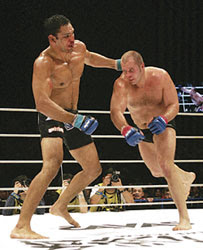
I first watched Fedor fight live a few years ago. He was facing Matt "The Law" Lindland, a highly-accomplished wrestler and mixed martial artist who had moved up in weight to challenge the Russian legend at heavyweight. The aggressive, hungry Lindland quickly drew blood, tagging Fedor and opening a nasty cut over his eye. The two clinched, with Lindland looking to get control. After a brief (and slightly controversial) struggle against the ropes, the two fell together to the mat, where Fedor ended the fight with an armbar before anyone realized what was happening. Fedor Emelianenko, winner via first-round submission. I had to watch the replay to understand it.
The guy is just different.
Slightly undersized for a heavyweight at just six feet tall and a slightly pudgy 230 pounds, Fedor really doesn't look like much. He enters the arena with relatively little fanfare, making his way slowly to the ring with his eyes glued to the floor. He doesn't jog-and-box, deliver high fives to fans, or mug for the camera. Rather than the aggressive hard rock or metal most fighters use to set the mood, Fedor is instead accompanied by the subdued and unsettling sounds of Era's "Enae Volare Mezzo" or - even more inexplicably - Russian choral folk music. Upon introduction by the announcer, he acknowledges the audience with a characteristic wave to either side.

When the referee calls the fighters to the center of the ring to review the rules and touch gloves, conspicuously absent is the uber-macho staredown nearly all fighters make a habit of. Fedor instead gazes serenely at his opponent's belt buckle or the mat, moving only to touch gloves. So calm and relaxed is he that he could just as easily be standing in his kitchen, slathering black caviar over rye bread and cucumber slices.
His pre-fight entrance is always the same...understated, respectful, and ironic. It is ironic because when the bell sounds, Fedor Emelianenko transforms into The Baddest Man on the Planet.
Fedor doesn't just charge right away like a bull in a china shop. Like most fighters, he takes a moment to size up his opponent and find his range. When he finally does charge, however, it is fast. Fast as in, hidden-predator-fish-snatching-other-fish-from-underneath-a-rock fast. It's just not a big enough word. There's something primal and efficient about the way Fedor accelerates into his attack. You rarely see him miss or abandon an offensive, so calculated is his style. It's as if he won't undertake any attack that won't connect or otherwise improve his position. Fedor's acceleration continues to take his opponents by surprise.
Another facet of Fedor's game his opponents seem to be at a loss to prepare for is his incredible reaction time and ability to adjust during the course of the fight. For example, Andrei Arlovski, a larger, stronger, and faster fighter, pushed Fedor around the ring for the better part of an entire round with crisp and disciplined boxing. With his straight punches easily keeping Fedor at bay, things were looking great for Andrei, who felt confident enough to launch a flying knee. Unfortunately, in that infinitesimal fraction of a second during which Andrei positioned his shoulders and hips to launch that flying knee, Fedor (1) recognized the vulnerable position Andrei would put himself in for about .26 seconds, and (2) simultaneously conceived and launched a preemptive attack in the form of an overhand right that landed flush, knocking Arlovski out. Stone-cold. After watching Fedor lose his first round in a long time, no one saw this coming.
Fedor later mentioned that he never once felt in danger of losing the fight, that he was in fact confident that his opponent would eventually make a mistake and he would then capitalize. Hindsight, of course, is 20-20, but maybe there's something to this patient methodology of Fedor's. He does few interviews, but in a recent documentary spoke of a training camp and fight preparation that was relatively rudimentary, involving just dieting, jogging outdoors, bodyweight exercises and calisthenics, and of course wrestling and sparring. He mentioned that his fight strategy isn't really affected by the opponent he faces, and that he prepares more or less the same for all opponents, and watches very little tape. As mystifying as this seems, it stands to reason that this could in fact be the secret to his success.
Fedor Emelianenko possesses an approach to fighting that seems fundamentally different from other fighters. While others spend hours watching tape and learning what their opponents' attributes are and how to mitigate those perceived advantages, Fedor instead focuses on arming himself with the physical tools - balance, quickness, punching power, and cardio - necessary to execute effective ad hoc fighting strategy...dynamically, and on demand during the course of a fight whose outcome or nature cannot possibly be predicted from watching tape.
Certainly there are stronger men, better boxers, better jiu-jitsu practitioners, and better wrestlers out there than Fedor Emelianenko. Fedor's greatest tool is his mind; this is where he is perhaps without equal. Patience, discipline, composure, mental toughness - perhaps no other fighter in the world can match him in any one of these characteristics. His steadfast adherence to the "one-size-fits-all" dynamic fighting strategy is very much a big picture, high-level way of thinking. Fedor understands that it isn't really important that he appreciate his opponents' strengths or weaknesses, so long as he is able to recognize and take advantage of his opponents' mistakes as they occur in real time. As such, he trains accordingly.
It's a great metaphor for life, this idea of focusing one's efforts only on those things one can control. Approach life's problems with strength, flexibility, and a peaceful attitude. It's a way to be prepared for anything, and not only survive but thrive.
The proof is in the pudding; one only has to watch Fedor.